
Roof insulation is often talked about as a way to save energy in winter, but its role is much broader than that.
A well-insulated roof:
In older and traditional buildings in particular, roof insulation must also deal with moisture. When problems occur, they are rarely caused by the insulation itself, but by how moisture behaves once insulation is added.
That leads to the real issue: condensation.
The biggest long-term risk in insulated roofs is condensation, not rain.
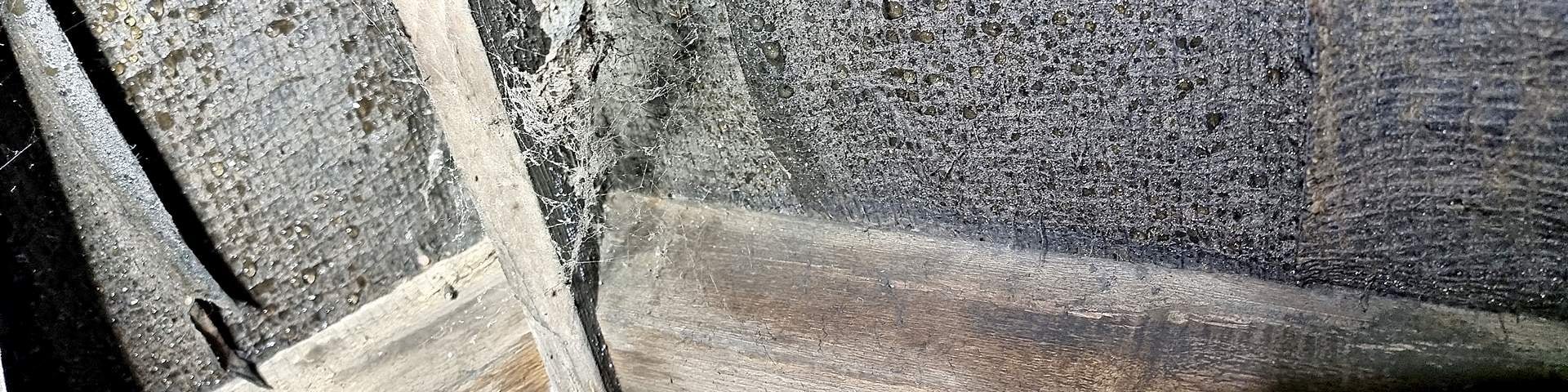
Rainwater is usually obvious and localised. Condensation is different. It is caused by warm, moisture-laden indoor air coming into contact with cold roof elements such as slates, roofing membranes, rafters, battens or metal fixings. When this air cools below its dew point, the water vapour it carries changes state and becomes liquid water on those cold surfaces.
Most serious condensation problems are not caused by moisture slowly seeping through materials (a process known as vapour diffusion), but by air movement. Warm air leaking through gaps, cracks and service penetrations can carry far more moisture into a roof than slow movement through solid materials. This is why roofs can suffer severe condensation even when “breathable” materials are used, if the overall moisture strategy is wrong.
This is driven by basic physics. Warm air can hold far more moisture than cold air. As temperatures fall within the roof build-up, even small amounts of moisture can condense repeatedly, often on the coldest materials first. Adding insulation increases this risk if moisture control is not addressed, because it keeps heat inside the rooms and allows roof elements above the insulation to remain colder for longer periods.
Condensation in roofs is rarely a single event. It typically occurs night after night during cold weather, depositing small amounts of water that may never fully dry. Over time, this leads to timber moisture contents rising above safe levels, corrosion of metal fixings, mould growth and gradual structural decay. Because this moisture is spread over large areas rather than concentrated in one place, the damage often remains hidden for years.
Understanding condensation is therefore central to roof insulation. Roof insulation is always a dual task: reducing heat loss while managing moisture safely. Insulation that focuses only on thermal performance, without considering how moisture enters the roof, moves through it and leaves it again, will almost always create long-term problems.
Every successful roof insulation system is designed to deal with moisture first, and heat loss second. How a roof controls moisture depends directly on where the insulation sits within the roof structure. This leads to two fundamentally different approaches: the cold roof and the warm roof.
When insulation is placed below the roof structure, leaving rafters, battens and slates cold, the roof behaves as a cold roof. This is how roofs in traditional British buildings have almost always worked, even if they were never described in these terms. Historic roofs were built with loose construction, breathable materials and plenty of unintended ventilation. As a result, some warm, moist air from inside the building would always enter the roof space.
This was not a flaw, but an accepted condition. Moisture control relied on ventilation and drying, not on sealing. Moving air carried moisture away before it could accumulate and cause damage. For this reason, cold roofs must remain ventilated and must use vapour-open materials that do not trap moisture. Blocking airflow or introducing vapour-closed insulation removes the roof’s ability to dry and greatly increases the risk of condensation and rot.
Cold roofs are therefore designed to dry, not to seal. This drying-based logic explains why traditional roofs often performed reliably for centuries despite limited insulation and no modern membranes.
Typical cold roof construction (outside to inside):
Semi-breathable roofing membrane: a semi-breathable (vapour-permeable) roofing membrane is a thin weather-protection layer installed directly under the roof covering that provides a secondary weather protection against wind-driven rain and snow, while still allowing moisture vapour to escape so the roof can dry. These membranes typically have Sd values around 0.02–0.05 m, which correspond to an equivalent μ-value range of 40–80. This means these semi-breathable membranes are less breathable than most lime plasters, but far more than plastic vapour barriers.
Ventilated air gap (typically 40–50 mm): the ventilated cavity allows outside air to move through the roof . This airflow removes moisture that enters the roof and is the primary moisture-control mechanism in a cold roof.
Vapour-open insulation: the insulation sits below the ventilation zone and must allow moisture to pass through without trapping it. Materials such as mineral wool, wood fibre, sheep wool or cellulose can tolerate small amounts of moisture and dry safely when ventilation is present.
Internal ceiling or lining: the internal ceiling forms the finished surface inside the room. It provides some resistance to air leakage and helps regulate indoor humidity, but in a cold roof it is not relied upon as the main moisture-control layer.
Airtightness at ceiling level is helpful, but perfection is not required.
When insulation follows the roof slope and surrounds the roof structure, the roof behaves as a warm roof. This approach developed much later, alongside modern insulation materials, improved airtightness techniques and tighter construction standards. The aim is to keep the roof structure warm enough that condensation is unlikely to form on it.
Instead of relying on ventilation, in a warm roof moisture control relies primarily on airtightness. Warm, moist indoor air originates on the heated side of the insulation, the side facing the rooms below. If this air is allowed to pass through the insulation and reach the colder parts of the roof, condensation can form. To prevent this, a continuous airtight layer is installed on the warm, room-facing side of the insulation, stopping moist air before it can travel into colder roof elements above.
However, modern warm roofs are not intended to be completely sealed with impermeable plastic barriers. Experience has shown that moisture can still enter roofs from other sources, including minor leaks, wind-driven rain and construction moisture, all of which occur on the cold side of the insulation, closer to the roof covering and the external environment.
For this reason, well-designed warm roofs usually use vapour-variable or semi-permeable membranes on the warm side. These membranes significantly reduce moisture entry in winter, when condensation risk is highest, but still allow controlled drying when conditions reverse. Warm roofs therefore aim to limit moisture entry while preserving a drying path, rather than relying on absolute sealing.
Warm roofs can perform very well, but they depend on careful design and workmanship and are generally less forgiving than traditional cold roofs if mistakes are made.
Typical warm roof construction (outside to inside):
Roof covering: slates or tiles form the first line of defence against the weather. Their primary role is to shed rain, snow and sunlight while protecting the layers below. They are not airtight or watertight on their own, which is why the layers beneath are critical.
Semi-breathable roofing membrane: a semi-breathable (vapour-permeable) roofing membrane is a thin weather-protection layer installed directly under the roof covering that provides a secondary weather protection against wind-driven rain and snow, while still allowing moisture vapour to escape so the roof can dry. These membranes typically have Sd values around 0.02–0.05 m, which correspond to an equivalent μ-value range of 40–80. This means these semi-breathable membranes are less breathable than most lime plasters, but far more breathable than plastic vapour barriers.
Insulation following the roof slope: this is the main thermal layer. By following the roof slope and surrounding the structure, it keeps rafters and decking warm, reducing the likelihood that condensation will form on them.
Airtight / vapour-variable membrane (warm side): this layer sits on the room-facing (warm side) of the insulation. Its main role is to stop warm, moist indoor air from leaking into the roof in large quantities which is by far the fastest and most dangerous way moisture enters roof structures. Vapour-variable membranes reduce moisture entry during cold periods while still allowing controlled drying if moisture enters the roof from elsewhere.
Internal lining: the internal lining forms the finished surface of the room. It protects the layers behind, contributes to airtightness, and helps regulate indoor humidity. Lime-based finishes can also provide additional moisture buffering.
Ventilation above the insulation is reduced or omitted because moisture control occurs at the warm side.
Even when the overall roof strategy is correct, local condensation risks can still occur at beams, steel elements, junctions and other cold bridges. These are best dealt with locally, using breathable, vapour-open materials that complement the main roof construction.
The aim is not to seal these elements, but to raise their surface temperature and allow safe drying.
Suitable breathable materials:
Aerogel plaster thickness – what it achieves:
As a general rule, 20–30 mm of aerogel lime plaster provides effective and proportionate protection.
These local treatments do not replace roof insulation and do not change the roof type. They simply make the chosen strategy work more reliably.
Cold roofs and warm roofs are complete systems with different assumptions about how moisture enters, moves through and leaves the roof. Problems arise when elements from one approach are introduced into the other without understanding the underlying moisture logic.
Cold roof failures most commonly occur when modern vapour-closed materials are added to a roof that still relies on ventilation for drying.
Typical examples include PIR or PUR boards, XPS, foil-faced insulation, spray foams, plastic vapour barriers and tightly sealed membranes installed within the roof build-up. These materials block vapour movement and inward drying. At the same time, ventilation paths are often reduced or obstructed, either intentionally or accidentally. The result is that warm, moist air still enters the roof, as it always has in traditional buildings, but is no longer removed effectively. Moisture then accumulates on cold timbers, fixings and membranes, leading to condensation, mould and rot. Lime or “breathable” finishes applied internally cannot compensate for this, because the vapour-closed layer dominates the behaviour of the roof.
Warm roof failures tend to occur for the opposite reason. Warm roofs assume that moisture is controlled primarily by airtightness on the warm side of the insulation.
Problems arise when this airtight layer is incomplete, poorly detailed or punctured by services, while above the insulation ventilation has been reduced or eliminated. Typical mistakes include relying on plasterboard alone for airtightness, using loosely fitted polythene sheets or omitting an airtight layer altogether. Moist air then leaks into the roof structure but has limited ability to escape. If vapour-closed materials such as rigid foams or foil layers are also present, moisture becomes trapped within the roof build-up. Because warm roofs rely far less on ventilation and far more on sealing, even small defects can lead to significant moisture accumulation over time.
The correct materials in a warm roof, again follow directly from the strategy. A continuous airtight layer is required on the warm side, preferably a vapour-variable membrane rather than a fully impermeable vapour barrier. The insulation must keep the structure warm while still allowing controlled drying if moisture enters from outside sources such as minor leaks, wind-driven rain or construction moisture.
Many roof failures occur after well-intentioned upgrades that combine modern materials with traditional construction without redesigning the roof as a whole. The roof is no longer able to dry itself as a cold roof, but is also not airtight enough to function as a warm roof. Moisture is allowed in but has no reliable exit route.
A roof must therefore follow one clear strategy. It must either remove moisture through ventilation, as traditional cold roofs do, or limit moisture entry through airtightness with controlled drying, as modern warm roofs aim to do. Trying to do both halfway usually does neither, and this is the root cause of most condensation-related roof failures.
The best roof insulation strategy depends on how your roof is built now, not on preference, product choice or theoretical performance.
Most roofs already behave either as a cold roof or a warm roof, even before any insulation is added. The safest and most durable approach is usually to work with the existing moisture strategy, rather than trying to force the roof into a different system.
Choose a ventilated (cold roof) strategy if your roof already behaves as a cold roof, when:
This approach accepts that some moisture will enter the roof and focuses on removing it safely through ventilation and drying.
Choose an airtight (warm roof) strategy may be appropriate if your roof is being fundamentally altered, when:
This approach works best when airtightness can be achieved continuously and carefully, so that moisture is kept out of the roof structure in the first place.
Roof insulation is not only about insulation; it is also about moisture management. The two must be addressed together. Insulating a roof without understanding how moisture is meant to behave is the main reason roofs fail after energy upgrades.
This is particularly important in older buildings.
Most traditional British buildings were never designed to be airtight. Their roofs behave as cold roofs and should normally continue to follow a ventilated, vapour-open strategy, unless the roof is fully rebuilt as a warm roof.
Trying to impose modern sealed systems onto traditional structures without redesigning the whole roof often leads to hidden moisture damage. In these buildings, allowing materials to dry safely is usually more important than achieving the highest insulation value.
Here are some other related pages that you might want to read to broaden your knowledge in this field.
Here are some practical solutions related to this topic:
Here are the some recommended materials / products that can help solving or dealing with some of the problems discussed on this page.


