
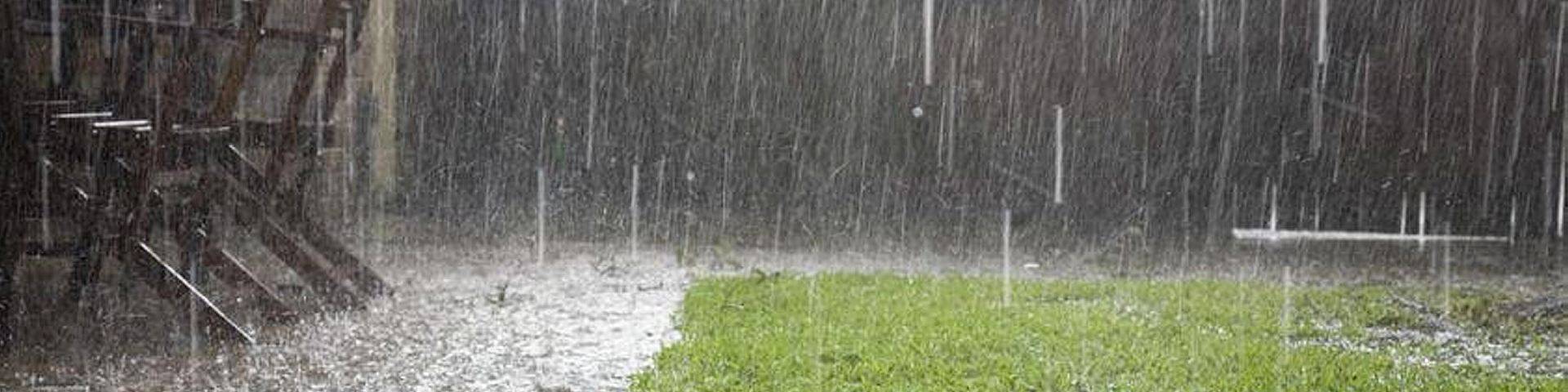
Britain’s climate is uniquely harsh on buildings. Wind-driven rain, often combined with salt-laden air and low winter temperatures, creates one of the most persistent forms of dampness in traditional masonry. In much of the country, rain does not fall vertically but at an angle, and on the western coasts most rainfall arrives horizontally. For old solid-walled buildings, this means walls are repeatedly soaked by wind pressure, not just gravity.
According to traditional conservation theory and standard laboratory testing, rainwater rarely penetrates more than 20 to 30 mm, the inner face of wall remains dry and the process repeats indefinitely without harm.
This behaviour is supported by controlled testing: brick or render panels exposed to vertical rain under still-air conditions. These walls wet rapidly for the first hour, then level off and once the rain is over and conditions become drier, vapour diffusion and evaporation remove the water within a few days. Here is this process in more details:
Surface wetting: rain hits a dry wall and wets the surface, forming a thin film of water. Without strong wind, the water stays mostly on the outside and not being pushed in.
Initial absorption: the tiny pores at the surface begin to draw in some water, pulling it a short distance (20-30 mm) into the wall.
Shallow penetration: as those surface pores fill, they lose their ability to pull in more water. Deeper inside the wall, trapped air resists further entry, so moisture usually penetrates only a few centimetres.
Drying begins: once the rain stops, moisture starts to leave the wall. Water at the surface evaporates, and moisture inside moves outward as vapour.
Return to dry: given a few dry, breezy or sunny days, the outer part of the wall dries out and returns to its normal, dry condition.
That’s why conservation guidance often claims that "a sound lime-pointed wall gets wet on the outside but stays dry inside" — and in the lab this theory works perfectly. However, for this cycle to work, several conditions must align perfectly:
This is often not the case in real buildings.
In real buildings, things are rarely ideal. Once any part of this balance changes — the weather, the materials or the wall’s condition — the "20–30 mm wet zone" theory collapses. Here is why this happens in Britain’s windy, salt-laden climate:
In much of Britain, particularly in exposed western and upland regions, these conditions are rarely met. During winter, rainfall commonly occurs every other day, with rain events every 1 or 2 days, and the very humid, cool and wind-affected air offers limited drying potential. When new rain arrives before the wall has recovered, moisture is added to an already damp fabric and moisture starts accumulating incrementally. Over weeks and months, this cumulative effect drives moisture progressively deeper into the wall, converting what should be a temporary, surface-limited phenomenon into a ongoing internal moisture load.
Moderate winds of 20 mph (≈9 m/s) generate a dynamic pressure of roughly 5–6 kg per m2 (50–60 pascals). This is more than enough to push water into open lime joints, bedding planes and small imperfections in masonry that would otherwise resist capillary wetting.
At the other end of the scale, winter storms with wind gusts of 70 mph (≈31 m/s) or more produce pressures in excess of 55–60 kg per m2 (550–600 pascals) — comparable with the weight of a full person pressing constantly against every square metre of wall surface. Under these conditions, rain is no longer simply wetting the surface; it is actively driven into cracks, interfaces between materials and partially saturated pore networks. Once a wall is already damp, capillary resistance drops further, making pressure-assisted ingress even easier. The result is moisture driven into the depth of the wall well beyond the shallow surface zone assumed in laboratory models.

Liquid water then follows gravity and capillary paths, being drawn deeper into the masonry rather than let go outward. In this way, the normal drying process reverses: evaporation turns into condensation, and outward vapour movement becomes inward liquid movement, keeping the wall wet. This effect is strongest on shaded elevations, dense or impermeable coatings especially during cool, windy weather — all such conditions being common in Britain.
Salts also keep walls wet even when weather conditions would otherwise allow drying. Many building salts are hygroscopic, meaning they chemically absorb moisture from humid air. This chemically bound moisture is reluctant to leave, so evaporation becomes much slower than in the absence of salts. In porous media, salt presence and salt-crust formation can reduce evaporation by up to 10 times, resulting in a much damper masonry.
For centuries, builders across Britain and northern Europe understood that they couldn’t stop the rain — they could only manage it. Their answer was simple and brilliant: lime rendering, or in Scotland, lime harling.
Lime rendering or harling is a roughcast lime coating thrown onto exterior walls to protect them from rain and wind. It wasn’t about decoration but about function and durability. It kept the wall slightly damp during storms but allowed it to dry completely afterwards. Because lime is flexible and breathable, the coating expanded and contracted with the wall and even healed small cracks over time. It sheds rain and at the end of its life decays gracefully, protecting the wall beneath.
The results speak for themselves: many harled buildings in Scotland and Ireland — from medieval castles to Georgian houses — have stood for centuries because the lime render sheds the weather but let the wall breathe.
The lime render forms a tough, slightly porous skin that:
It achieves this by balancing two natural actions:
In effect, the wall and the render “breathe” together. Moisture never builds up deep inside — it stays safely near the surface from where it can evaporate.
When the render eventually weathers away, it can simply be reharled. Each renewal gives the wall another generation of protection, making it one of the simplest and most sustainable maintenance methods ever developed.
In the early 20th century, Portland cement replaced lime in most forms of construction, including rendering. It was cheap, fast-setting and promised a waterproof, strong finish that didn’t need renewal every few decades.
At first, it looked like a miracle solution. Walls stayed visibly dry, rain rolled off and maintenance appeared minimal. But over time, hidden problems began to appear:
Cement’s very strength was its weakness. It was too hard, too dense and too impermeable for old walls that rely on breathability to stay dry.
Here are some key differences between lime and cement renders:
For ordinary rain exposure and regular weather, lime rendering remains the best solution — it protects without trapping water, and its slow, graceful weathering makes it easy to maintain.
Even lime has limits. In harsh, exposed climates or on walls with chronic damp, a lime render begins to lose its balance. It may remain wet for weeks, unable to dry between storms. Moisture then migrates inward and salts from rising damp or sea air crystallise under it, shortening its lifespan.
This problem isn’t limited to the coast — even inland buildings suffer, as salts from rising damp concentrate in the lower zones of the wall. Here, the render coat begins to flake and powder prematurely.
At this point, the render still performs better than cement, but it needs help — something that resists liquid water and salts without closing the wall.
Rinzaffo MGN is based on ancient Roman pozzolanic technology, the same principle that allowed Roman bathhouses, cisterns and sea walls to survive thousands of years of dampness and salt.
Made from air lime, natural hydraulic lime, volcanic pozzolans, marble powder and washed sands, Rinzaffo is a mineral plaster that hardens through both carbonation and pozzolanic reaction. This blend produces a resilient yet breathable microstructure that gives Rinzaffo a set of unique, powerful properties ideal for conservation and long-term wall protection. Here is the science behind it:
Traditional solid walls do not fail because they get wet; they fail because they cannot dry safely. The solution is not to seal the wall, but to manage how water enters, moves through and leaves the fabric. Used together, Rinzaffo and lime render form a two-layer breathable system that does exactly this — separating the control of rainwater from the handling of weather.
The lime render forms the outer skin of the wall, typically 15–20 mm thick, and has long been the traditional response to wind-driven rain in exposed parts of Britain. Its purpose is not to make the wall waterproof, but to manage how rain strikes and wets the surface.
During rainfall, the lime render accepts surface wetting and breaks up wind-driven rain. Its rough, open texture disperses impact, sheds splash and reduces local pressure at joints and surface irregularities. Some moisture is absorbed into the lime render itself, but this wetting is temporary. Once the rain stops, the render dries quickly, releasing moisture back to the air and restoring breathability.
For ordinary exposure, this works extremely well — which is why lime renders have protected buildings for centuries. But a lime render has limits. In very exposed locations, under frequent rain, strong winds or where salts are present, the render may remain wet for long periods. Drying times become too short, moisture can migrate inward, and salts can crystallise within or behind the render. At this point, the outer layer alone is being asked to do more than it was ever designed to do.
This is where the system needs help — not by sealing the wall, but by adding a layer that controls liquid water and salts penetration without blocking vapour.


Rinzaffo is applied directly onto the masonry under the render as a lime base coat, typically around 20 mm thick. Its role begins where the render coat's role ends.
Rinzaffo does not deal with surface exposure, splash or weathering. Its role is to stop liquid water from penetrating further into the wall. During rain, wind-driven water may wet the outer render or harling and even pass through it, but Rinzaffo prevents that liquid water from being driven into the masonry itself and building-up over time.
At the same time, Rinzaffo is vapour open and vapour-active. Moisture already present within the masonry — whether from historic dampness, residual moisture or earlier ingress — is able to move outward through the Rinzaffo layer as vapour. Salts carried in liquid water are held back, while moisture is progressively released. This creates the critical handover: above Rinzaffo (on the render side), moisture may exist as liquid water and dissolved salts; below Rinzaffo (within the masonry), moisture movement is dominated by vapour, allowing the wall to dry rather than re-wet.
Rinzaffo does not deal with surface exposure, splash or weathering. Instead, it defines the wall’s physical boundary. During rain, Rinzaffo stops all liquid water that has passed through or behind the render from entering the masonry. Wind driven rain may wet the outer layer, but liquid water cannot be driven beyond the Rinzaffo layer, into the fabric.
What Rinzaffo adds is liquid moisture control even in very demanding conditions. It prevents wind-driven rain overwhelming the outer render layer, ensures that liquid water cannot accumulate within the masonry, and maintains outward drying even when exposure is high and drying periods are short. In doing so, it allows traditional render coat to perform reliably in situations where it would otherwise be pushed beyond its natural limits.
Used together, a lime render and Rinzaffo form a layered moisture-management system in which each material performs a distinct and complementary role.
The outer render or harling manages exposure, absorbing impact, shedding rain, and releasing surface moisture back to the air. Rinzaffo, directly under it, controls what is allowed to progress further, stopping liquid water and salts while remaining open to vapour movement.
Because liquid water is arrested before it reaches the masonry, and vapour is never trapped, the wall is able to dry progressively rather than accumulate damp. Salts are kept away by the Rinzaffo from vulnerable surfaces, drying remains outward-driven and the system remains stable even under frequent and extreme wind-driven rain and short drying periods.
In this way, Rinzaffo does not replace traditional lime rendering — it extends its effectiveness, allowing a time-proven weathering system to continue performing where exposure and salt loading would otherwise overwhelm it.
Here are some other related pages that you might want to read to broaden your knowledge in this field.
Here are some practical solutions related to this topic:
Here are the some recommended materials / products that can help solving or dealing with some of the problems discussed on this page.
Here are some of our projects where we have dealt with some of the issues discussed on this page:


